Sushi IoT Board
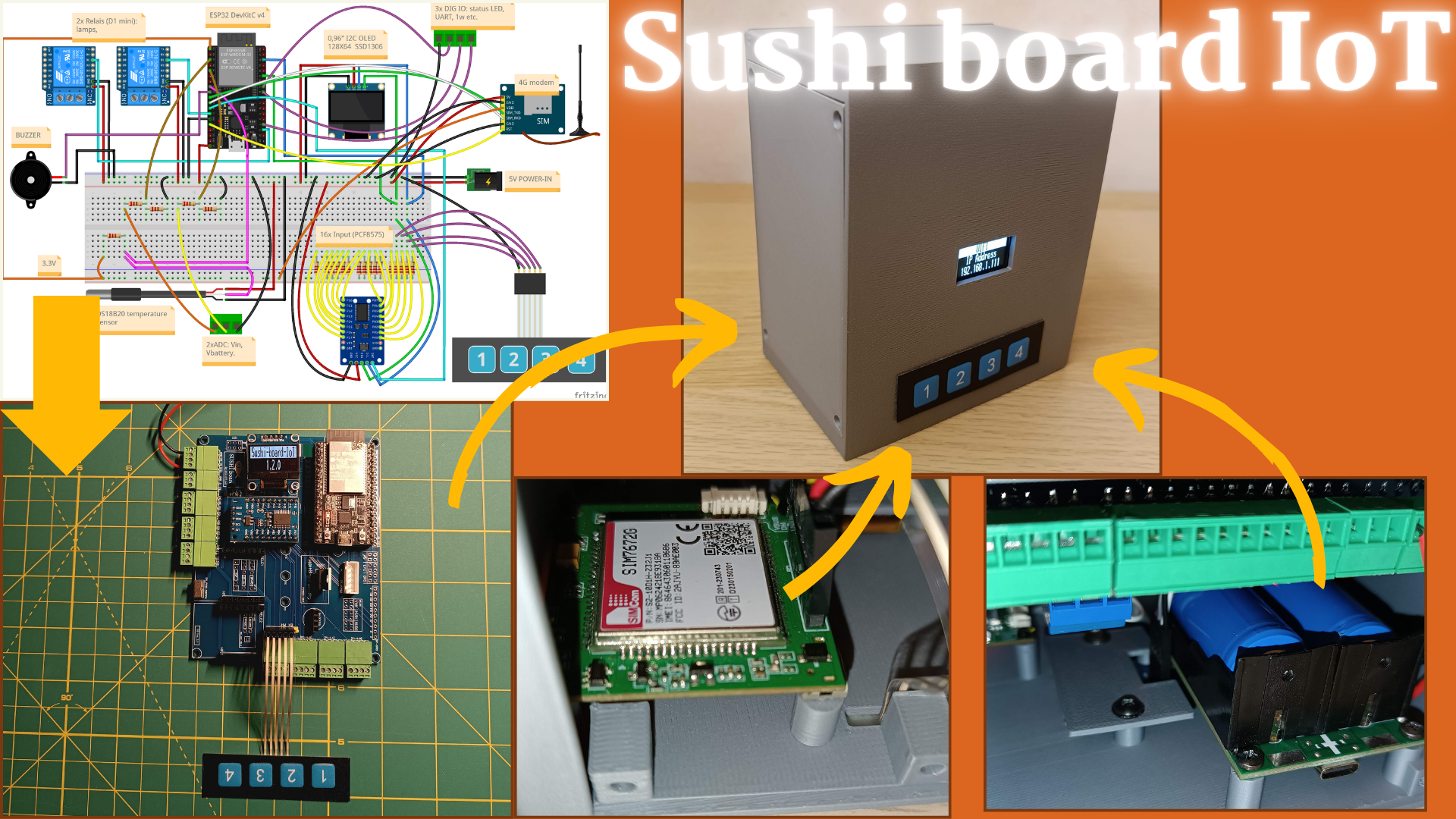
Sushi IoT is an ESP32-based programmable modular embedded system for general-purpose IoT, suitable for STEM education, DIY electronics, edge computing and fast prototyping projects. 100% based on widely available commercial modules, making it cost-effective and easy to source.
- Sushi Board GitHub repo
- Examples & projects
- Sushi-IoT on Instagram
- Sushi-IoT on HACKADAY
- SushiPython IoT framework
- Buy a Sushi Board on Tindie
Fully supported by SushiPython: a firmware that provides a solid foundation for IoT and Edge Computing projects, programmable via MicroPython scripts according to specific application needs. It accelerates development by handling all the necessary background system management, allowing you to focus immediately on your own application.
For makers, fast prototyping and DIY electronic projects.
- A carrier board that connect all the essential components needed to create a complete IoT unit, suitable for various applications, minimizing the complexity of assembling different components and boards without requiring extensive soldering or wiring.
- Only the CPU is mandatory; then you simply plug in the modules you need for your specific purposes.
- 3D Case: to complete the system and adapt it to various contexts, several parametric 3D-printable case models are available.
For students and educational purposes
- Sushi Board offers a modular system that can be shared across multiple projects, from simple setups to more complex, DIY electronics systems.
- It’s not just for desk experiments; you can build something practical and functional.
Perfect even for Beginners: allows non-experts to jump-start their learning journey with a "step-by-step" guide and ready-to-use examples. It's an all-in-one path to learn:
- Hardware Recognition: Learn to identify various system components.
- Easy Solderless Assembly: Simple setup with only a mini-screwdriver.
- MicroPython programming with immediate results. The system is ready to be powered on and programmed in minutes, eliminating difficult technical hurdles.
Advantages
- Based on ESP32 SoC: a reliable choice in the IoT field. You have access to a powerful ecosystem with numerous resources available online.
- 100% based on very common commercial modules widely available online for Arduino and DIY electronics projects. Sushi board just help you connect them all together.
- You can code with your favourite compiler (Arduino, microPython, Scratch, ESP-IDF, etc) or rely on SushiPython.
- Open source hardware: both the CPU module and the Sushi Board come with wiring diagrams provided.
- 3D paramametric cases available.
Applications
- Generic IoT & sensors educational experiment
- Fast prototyping
- Edge computing hubs
- Home automation systems
- IoT central units
- Alarm systems
- Domotics servers
- Remote monitoring and data sampling systems (example weather centrals)
- Local and remote devices control (by local user interface, web interface, modem interface)
Hardware features
All the ingredients that are needed for a myriad of applications:
- ESP32-DevKitC V4
- 16x digital GPIN
- 2x Relay OUT (10A 250V AC)
- 5x digital direct GPIO, 1 x GPO , 2 x GPI (LEDs, extra UART, etc.)
- Physical keyboard
- OLED Display
- Connectivity: Wi-Fi, Bluetooth, modem 2G/3G/4G, UART, I2C
- Power supply modes: 5V (USB adapter or wired) ; Battery only ; 5V + backup battery (for when grid power is missing)
- Backup battery
- Power status and battery level acquisition
- Buzzer for audio alerts
- Temperature sensor
- Size: 90x110 mm (both carrier and TOP boards)
Why Sushi ?
The name "Sushi board" comes from the idea that, like sushi—a traditional Japanese specialty—the Sushi board is composed of various ingredients (the modules) that can be added or customized based on your preferences.